AI model speeds up by 700 times the simulation of optical filters for neutrino detectors that help study the universe
Developed at UNIFAL-MG, the tool combines the laws of physics and machine learning to support DUNE - an international neutrino detection experiment
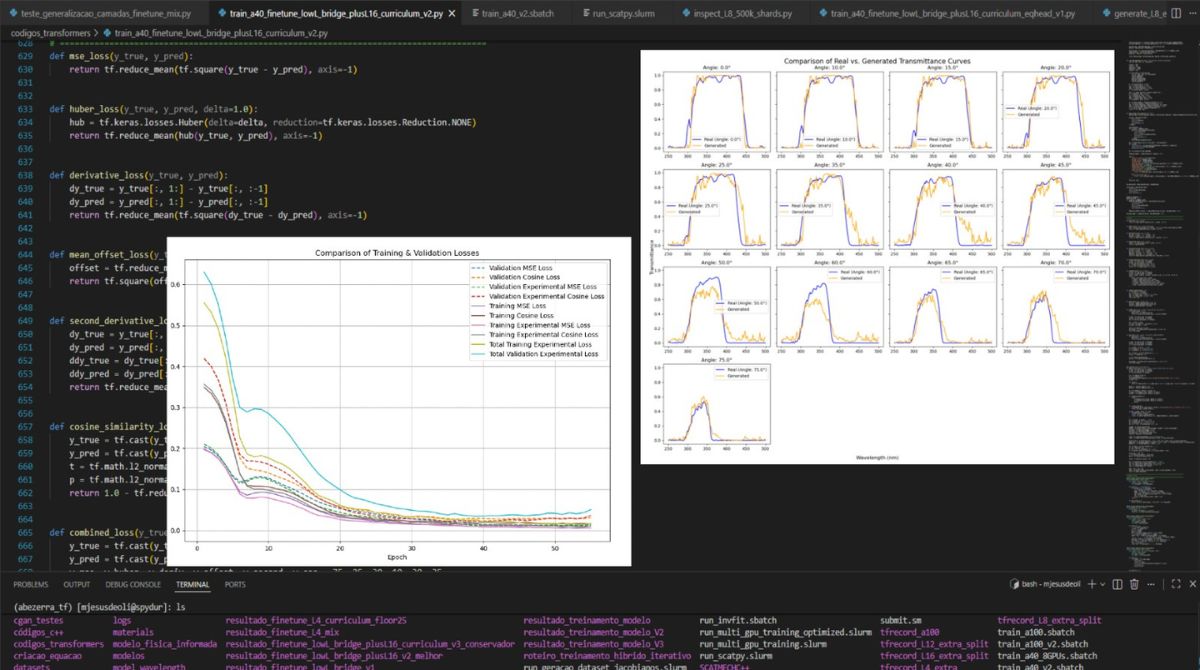
UNIFAL-MG researchers developed a machine learning model that, with little real data, was able to generate optical simulations of filters used to capture the neutrino signal. The solution proved more accurate and up to 700 times faster than the traditional simulation method.
The study was part of the master’s degree of Mateus Jesus de Oliveira Rodrigues, supervised by professor Anibal Thiago Bezerra in the Graduate Program in Physics (PPGF), and contributes to the international experiment DUNE (Deep Underground Neutrino Experiment), in which UNIFAL-MG is one of the participating Brazilian institutions.


An early challenge in developing the research, titled Machine learning in the detection of neutrinos from supernovae, was the scarcity of data. The researchers had few real curves to train the model. As Anibal Bezerra explains, machine learning systems usually require a large volume of data, and the available material would not have been enough.
To get around this limitation, the solution was to train the model in two stages. First, the team used 500 curves generated by the conventional method, the TMM (Transfer Matrix Method), which uses physics equations to describe how light passes through the filters. These curves do not faithfully reproduce the optical response of the real filter, but they give the model a broad base to learn from. Then the real measurements came into play to calibrate this base and show the artificial intelligence the details that the mathematical model (TMM) lacked.
The team also built physics into the model itself, named CPIGAN (Conditional Physics Informed Generative Adversarial Networks). “The ‘physics informed’ part highlights the fact that we teach the physics behind the optical response to the conditional generative adversarial models, the CGANs,” explains Anibal Bezerra.
As the researcher points out, optical filters are stacked layers of different materials that filter the light hitting them and can let only a few specific wavelengths through. It is through this rigorous filtering that they act as the “gateway” to the ARAPUCAS – giant traps designed to capture the glow of neutrinos.
Conventionally, simulation of these components is done with TMM, but, as the professor explains, this method is an approximation. “The method treats the interfaces between materials as perfect; it would be the optical analog of ‘ignore friction’ in mechanics problems,” he argues.
CPIGAN thus becomes a neural network model capable of reproducing the optical transmission results of real filters. “In addition, these models are computationally much faster than TMM. We showed an increase of more than 700 times in the speed of obtaining transmission curves when comparing CPIGAN with TMM,” emphasizes Anibal Bezerra.
According to the researcher, this is basic physics work, aimed at developing techniques that can be applied to building devices. “We believe it is a very relevant work for optical device engineering, with many applications in society. We designed a machine learning procedure that can be extended to other types of devices and properties with direct applications in the optics industry, for example,” he notes.
The next steps of the research are already underway. The team seeks to develop an even more general model, capable of learning the properties of devices with varying numbers of material layers. “It is a challenging work, for which we are already getting some very interesting results,” the researcher shares.
The research was supported by the Coordination for the Improvement of Higher Education Personnel (CAPES), which granted a master’s scholarship to student Mateus Rodrigues.
Visit the UNIFAL-MG page to read the full original text.